
As readers of this blog may know, I have been writing (strike that: have written) a book on Richard the Lionheart. While the book has not yet seen the light of day in the form of publication, hope springs eternal… In the meantime, you can read my running medieval substack that covers interesting topics from Richard’s era (if you’re into that sort of thing).
As part of that effort, I’m regularly trying to extract some factoid from a book written in Latin or Old French from the era. Many of those works either have never been translated into English, or only exist in eye-wateringly expensive ($250???) academic translations.
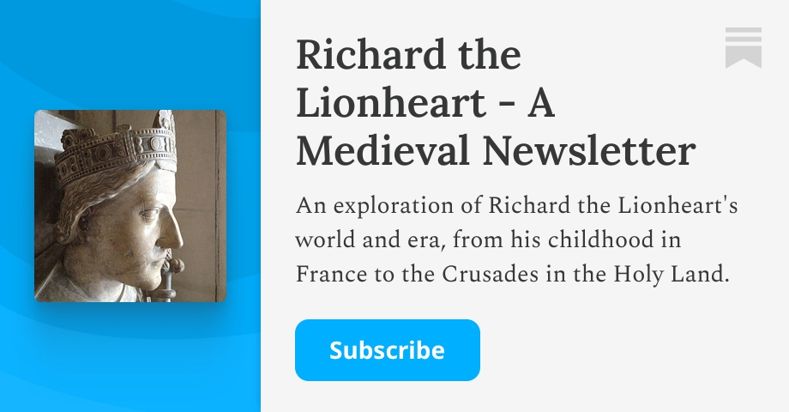
Well, AI is everywhere, isn’t it? So I built a chrome extension that OCRs and translates a page of an internet archive book you might be looking at. The Internet Archive is an amazing resource for old books. I’m not a fan of what they do in terms of scanning and making available under-copyright books, but for old books inaccessible any other way, it’s amazing.
Suppose you need (as I did) some details from Gerald of Wales’s 1216 De Principis Instructione (Instructions for a ruler)1. This work has some interesting factoids in it: it is the only work I am aware of that mentions the digging up of King Arthur’s body at Glastonbury (see here), and it is the only source that records Richard the Lionheart’s famous quote about his family, “from the devil we came and to the devil we will return,” which I wrote about here: (https://medieval.substack.com/p/from-the-devil-we-came-and-to-the).
Well, your first choice is to buy the only available English translation, by Bartlett. Taking nothing away from him, he has done great work for us on this, the only problem is that it costs $250. As Dave Barry would say, I am not making this up. Clearly this book is only meant to be bought by libraries. Or, you can read the Latin version on the Internet Archive, and try to piece together a translation (did I mention I don’t read Latin?)
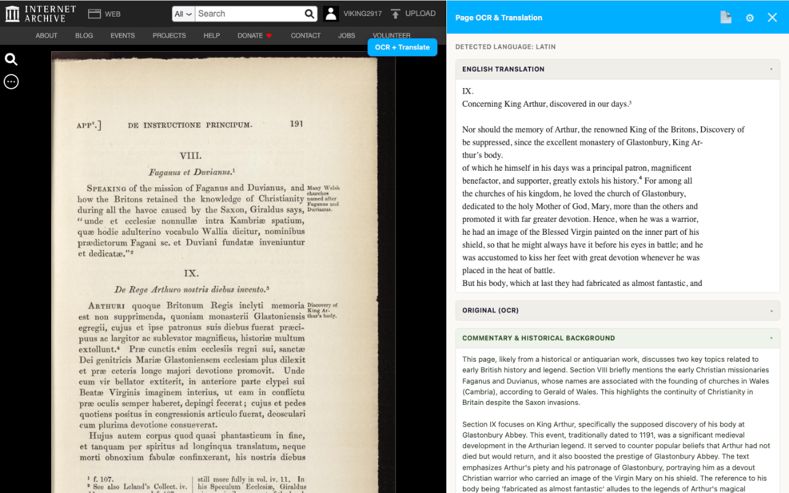
Or, you can use AI. So I did. I used Claude AI to create a Google Chrome extension that will show you a sidebar of every page, with an English translation, as well as commentary on the content. It works by taking a screengrab, then sending that to Google Gemini, and asking it to OCR the image (extract text from the image), then translate it to English. It works surprisingly well.
The extension is called “Bookxlate” (say “bookslate”), and you find find it here in the Chrome extension store: (https://chromewebstore.google.com/detail/bookxlate-archiveorg-book/mfefkdeojibnbabedjonpgmbgbfplbhe)
It is free, however, you need to supply your own Google Gemini API key, which is free, and which you can get here: (https://aistudio.google.com/apikey). You can compute a fair amount of translations on the free API tier, but if you plan to translate an entire book this way, you will likely end up paying for usage.
You can also find the code for this extension here on github:
Just for grins, here’s the passage about the discovery of King Arthur’s body:
Concerning King Arthur, discovered in our days.³
The memory of Arthur, the renowned King of the Britons, must not be suppressed, since the excellent monastery, of which he himself was in his days the chief patron, magnificent giver, and supporter, greatly extols it in history.⁴ For among all the churches of his kingdom, he loved the holy church of Glastonbury more and promoted it with far greater devotion than the others. Hence, although he was a warrior, he had an image of the Blessed Virgin painted on the inner part of his shield, so that he might always have it before his eyes in battle; and he was accustomed to kiss her feet whenever he was placed in the moment of conflict. But his body, which at last they had fictitiously made out to be almost fantastical, and as if translated by spirits to distant lands, and not subject to death, in these our days… at Glastonbury, between two pyramidal stones, formerly erected in the sacred cemetery, was found deeply hidden in the earth in a hollow oak, and marked with wondrous and almost miraculous signs, and was translated with honor into the church, and fittingly committed to a marble tomb. And there, a leaden cross, placed beneath a stone, not fixed in the upper part as is customary in [our] days, but rather in the lower part, which we ourselves saw, and whose inscribed letters we touched, not raised and prominent, but rather turned inwards towards the stone, contained these words: “HERE LIES BURIED THE FAMOUS KING ARTHUR WITH WENNEVEREIA HIS SECOND WIFE IN THE ISLAND OF AVALONIA.”
Here, however, many notable things occurred; for he had had two wives, the last of whom had been buried with him, and her bones were found together with the bones of the man, yet so distinct that two parts of the tomb, towards the head, were designated for containing the bones of the man, while the third part, towards the feet, contained the bones of the woman separately; where also a braid of the woman’s yellow hair was found with its pristine integrity and color, which, when a certain monk eagerly seized it with his hand and lifted it, immediately crumbled entirely into dust. Moreover, since some indications for finding the body there came from his own writings, some from the letters impressed on the pyramids (though much obliterated by extreme antiquity), and some also from visions and revelations granted to good and religious men, but most especially and most clearly King Henry II of England, as he had heard from an ancient British historical bard, indicated to the monks that they would find the body deeply, namely, sixteen feet or more in the earth, and not in a stone tomb but in a hollowed oak. And so the body had been placed so deeply and almost hidden, lest it should be found by the Saxons, who occupied the island after his death, whom he had fought against with such great effort while alive, and almost entirely destroyed; and for this reason also the letters, indicators of truth, impressed on the cross, were turned inwards towards the stone, so that they might conceal what they contained at that time, and yet sometimes reveal it according to places and times.2
Of course, I have no idea how accurate this translation is. ↩︎