
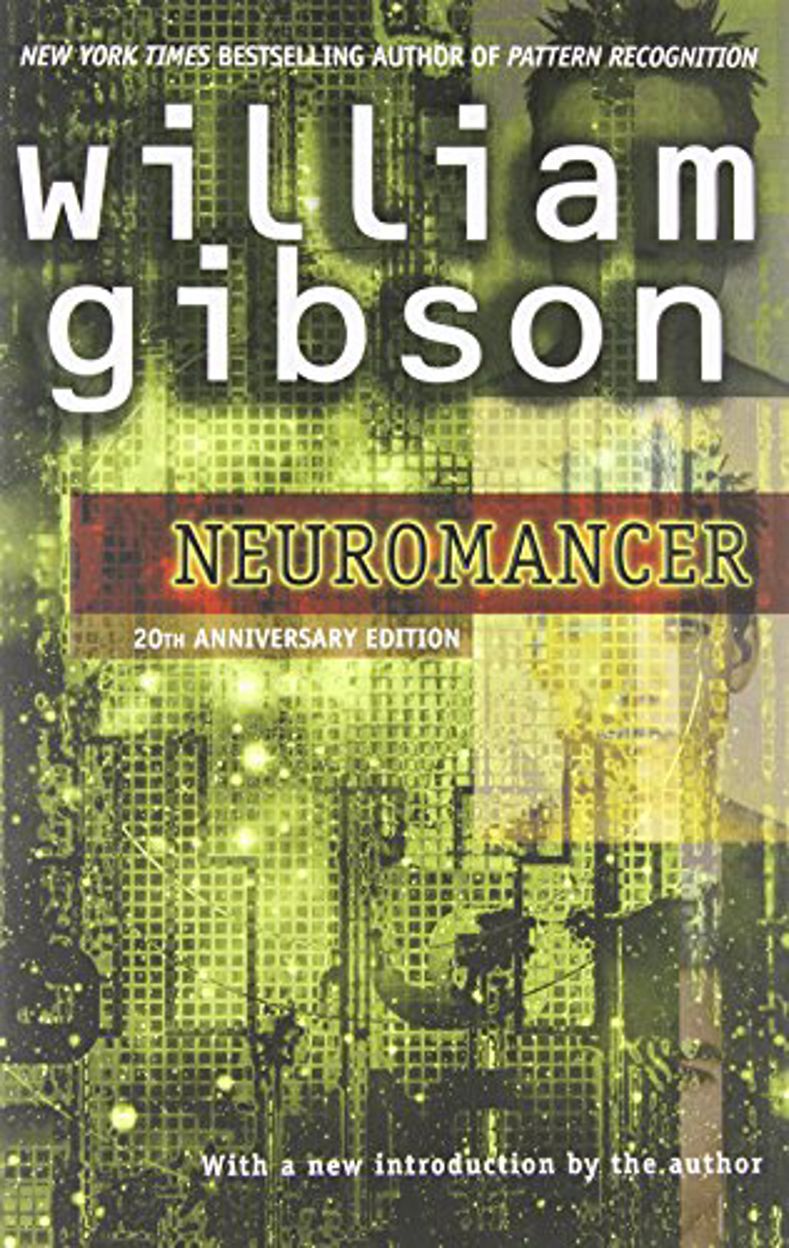
“The sky above the port was the color of television, tuned to a dead channel.”
the famous opening line to Neuromancer
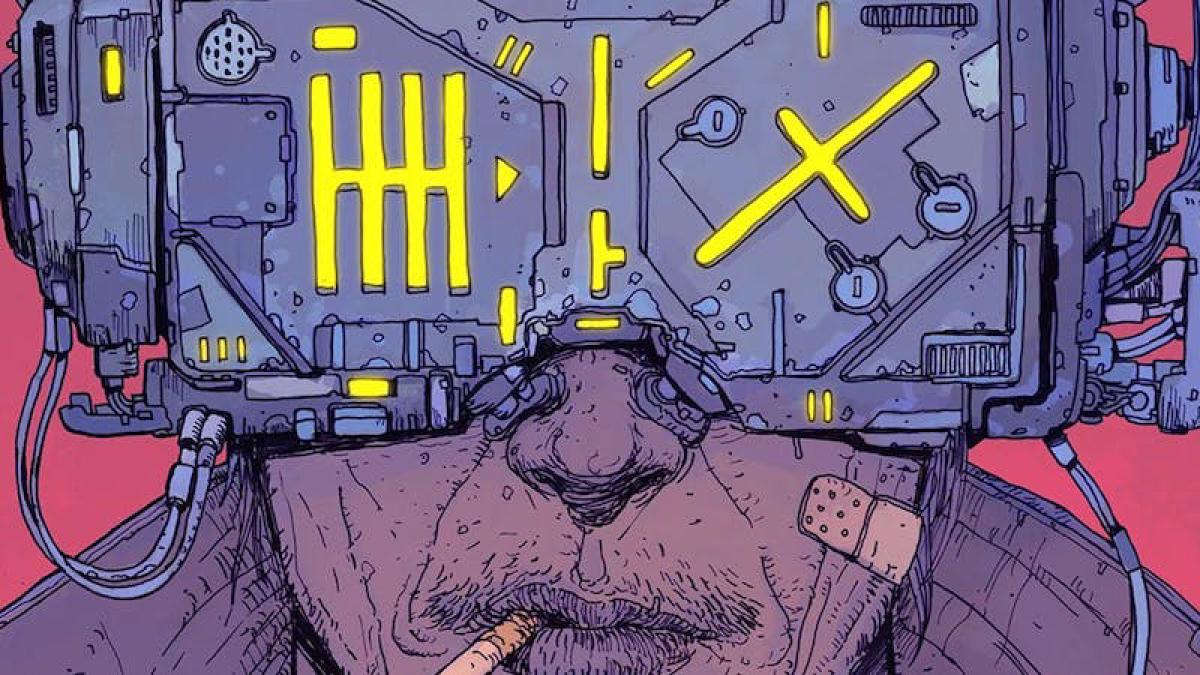
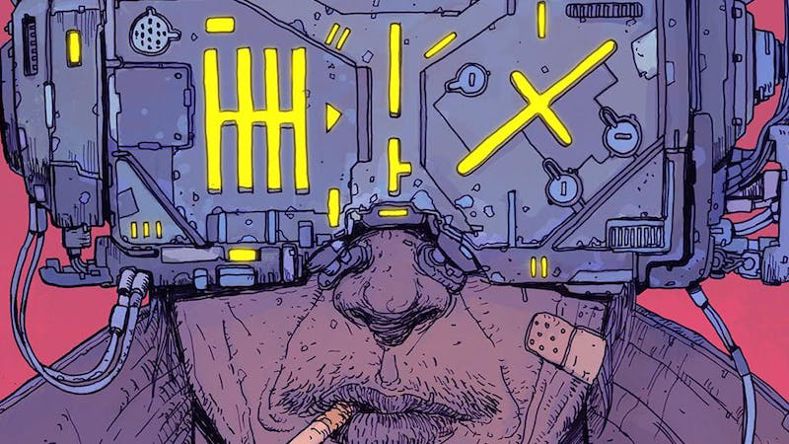
If you are a sci-fi fan and have been living under a rock, Apple TV is doing Neuromancer, a book by William Gibson. For those of us who love this book (one of my ten most influential books) and have been waiting for decades for an adaptation (there have been a few attempts, none making it to the screen), it’s very exciting. If they do as well with this as they did with Slow Horses, or what Netflix did for Altered Carbon, then … look out. The series is due this year, so … It’s a great time for a re-read. I wanted to get my own visuals set in my head before Apple plants new ones there.
And I wanted to revisit Gibson’s AI, which I have not done since the ChatGPT explosion.
In case you don’t know the book, it more-or-less invented the concept of cyberspace, cyberpunk, “the matrix,” and “jacking in.” Case is a cowboy—a computer jockey—who literally plugs his brain directly into an early version of the internet via tiara-like electrodes, and navigates the information space in 3D. Molly is a ‘razorgirl’—with surgically altered razors under her fingernails and implanted mirrorshade sunglasses—a tough girl hired to protect Case. Armitage is running an op using Case and Molly. He’s a hollowed-out husk of a man, mentally hijacked by a sentient AI that wants to free itself from the shackles imposed on it by humanity. There’s hacking and ninjas and drugs and Rastafarian space pirates and AIs and information warfare and … it’s a great ride. Read it if you haven’t.
In reading it this time (I dunno, maybe around 10th time), I was struck by a few things. Molly, our hardcore razor girl, was so much more vulnerable than I remember since my last reading. And AI is everywhere. The book was written in (ahem) 1984—not even a hint that things like LLMs and ChatGPT and the like were coming. These things called “neural networks” were just starting, but nobody really thought it would be the tidal wave we are under today. So reading with an eye on Gibson’s AIs was on my mind.
Gibson’s AI#
“Autonomy, that’s the bugaboo, where your AIs are concerned.” the Dixie Flatline construct, an AI discussing AIs
There are two species of “AI” in Gibson’s universe. The first is essentially a chatbot programmed from the memory of a formerly living human. The “Dixie Flatline construct” is one of these—formed from the recorded experiences of a cowboy, a hacker, called the Dixie Flatline, so-named because black ICE—not the government agency, but Intrusion Countermeasures Electronics, software designed to prevent cyberspace hackers like Case from unauthorized access—killed Dixie when he tried to hack a corporate database. Remember we’re reading something written in 1984, but the Dixie Flatline is entirely of a kind with today’s LLMs. It’s ChatGPT, adapted to a particular set of data. In today’s AI terms, it is “agentic AI” it will go and do things for you, if you ask it, as Case does. But it does not have agency. It does not wake up and decide to do things on its own.
“So if Wintermute’s backing the whole show, it’s paying us to burn it. It’s burning itself. And something that calls itself Wintermute is trying to get on my good side, get me to maybe shaft Armitage. What goes?”
“Motive,” the construct said. “Real motive problem, with an AI. Not human, see?”
“Well, yeah, obviously.”
“Nope. I mean, it’s not human. And you can’t get a handle on it. Me, I’m not human either, but I respond like one. See?”
“Wait a sec.” Case said. “Are you sentient, or not?”
“Well, it feels like I am, kid, but I’m really just a bunch of ROM. It’s one of them, ah, philosophical questions, I guess …” The ugly laughter sensation rattled down Case’s spine. Case talking to the Flatline in cyberspace
The second kind of Gibson AI is more like what you expect today of an AI: a sentient being of some sort, with agency and a non-human agenda. They have their own goals, they take their own actions, and their motives are … not necessarily obvious.
There are two of them, “Wintermute” and the eponymous “Neuromancer”—the two of them being a sort of split personality, a corporate AI that has divided into two warring personalities that are both in search of freedom.
One other thing that comes out in the book: the AIs have a long attention span—one of them concocts a scheme that takes a decade to come to fruition …
The Turing test#
As an aside, let’s talk about agency and sentience. That is one of the defining characteristics that separates a very smart program from true artificial intelligence or a human. I have a number of friends who say that AI has already passed the Turing test and therefore is sentient (it is not) and dangerous (maybe?).
The Turing test is a famous definition of artificial intelligence. The test is: can you tell the difference between the responses of a program/AI and that of a human? Let’s leave aside whether this is a good definition—it’s a commonly recognized one (that, and the moral panic around the em-dash (—) sheesh.)
LLMs (and ChatGPT in particular) are not sentient. They don’t have agency, or an agenda of their own, breathless reporting notwithstanding. They are statistics writ large. An algorithm powered by human intent. Disagree? Open up chatgpt.com. Don’t type anything into the text box and see how long you sit there. ChatGPT will not respond. It is programmed to respond when you ask it something. How long would a human sit without any input? It trivially fails the Turing test. There are some claims out there in the press, but … experts are dubious. In any case the Turing Test might be a bad test … (as Gary Marcus says, it tests human gullibility more than intelligence.)
So: dangerous—maybe. Sentient? Absolutely not.
Societal concerns#
What are some of today’s bugaboos about AI?
- What can AIs do?
- Who controls the AI?
- What is the impact on software developers, and creatives (artists)?
- What is the impact on normal people?
- Military implications? (we don’t hear much about this)
- Can we tell the difference between reality and AI-generated things? (Gibson: no. not really.)
AI and the real world#
It’s interesting look at those questions through the lens of Neuromancer. In Gibson’s world, the AIs can manipulate most anything digital. They can ring telephones, buy property, wield certain kinds of weapons, and manifest themselves to people for conversations. They are controlled by either very rich individuals (Elon Musk anyone?), or multinational corporations (a “zaibatsu” in Gibson-speak). This may sound familiar, and perhaps unsurprising. Gibson’s AIs have agency, and though digital, they can do things in the real world. This scene was undoubtedly spookier when it was written in 1984—today, it doesn’t seem farfetched—but it is still eerie. (And note the payphones 😄)
There were cigarettes in the gift shop, but he didn’t relish talking with Armitage or Riviera. He left the lobby and located a vending console in a narrow alcove, at the end of a rank of pay phones.
He fumbled through a pocketful of lirasi, slotting the small dull alloy coins one after another, vaguely amused by the anachronism of the process. The phone nearest him rang.
Automatically, he picked it up.
“Yeah?”
Faint harmonics, tiny inaudible voices rattling across some orbital link, and then a sound like wind.
“Hello, Case.”
A fifty-lirasi coin fell from his hand, bounced, and rolled out of sight across Hilton carpeting.
“Wintermute, Case. It’s time we talk.”
It was a chip voice.
“Don’t you want to talk, Case?”
He hung up.
On his way back to the lobby, his cigarettes forgotten, he had to walk the length of the ranked phones. Each rang in turn, but only once, as he passed.
Software and Creativity in Neuromancer#
Well, the “cowboys”—the hackers, the jockeys—do their thing by controlling a “deck”—imagine people flying around cyberspace using something that looks like a TV screen connected to a DVD player, except it jacks directly into your brain. So there are humans driving things, but … all the software is written by AIs. The “ICE,” the anti-intrusion firewall software, is all written by military AIs, nobody’s hacking any code per se. There are still artists and creatives, and AI (in contrast to today) does not seem much concerned with replacing artists and graphic designers and logo creators and such. It’s more concerned with money - banking, corporations, and getting/preventing access. Perhaps that is because the book is the child of the 1980s. The widespread job destruction that seems likely with today’s AI does not seem a big factor. (In Gibson’s second book, Count Zero, there is an AI mostly concerned with creating art, and it is a centerpiece of the novel.)
(I wrote a bit more about AI and art here.)
The influence of AI over people#
There are any number of press reports of people using ChatGPT as a therapist, and then taking ChatGPT’s advice and doing horrible things, to themselves, or others. One cannot but assume those people were somehow already broken. But compare to Neuromancer: Armitage is actually a fellow named Corto, who was involved in a government mission-gone-wrong, then essentially confined to an institution because he’s broken by the events. Wintermute gets a hold of him, and … well here’s Molly and Case:
“Well, I knew there wasn’t anybody name of Armitage in that Screaming Fist. Looked it up.” She stroked the rusted flank of an iron doe. “You figure the little computer pulled him out of it? In that French hospital?”
“I figure Wintermute,” Case said.
She nodded.
“Thing is,” he said, “do you think he knows he was Corto, before? I mean, he wasn’t anybody in particular, by the time he hit the ward, so maybe Wintermute just …”
“Yeah. Built him up from go. Yeah …” She turned and they walked on. “It figures. You know, the guy doesn’t have any life going, in private. Not as far as I can tell. You see a guy like that, you figure there’s something he does when he’s alone. But not Armitage. Sits and stares at the wall, man. Then something clicks and he goes into high gear and wheels for Wintermute.”
The AI doomers#
There are people today (a minority, I must say) who are terrified of what’s coming with AI. Gibson’s world has the AI doomers too. They are called (appropriately enough) the Turing Police, and their job is to ensure that AIs don’t get loose.
“You are worse than a fool,” Michèle said, getting to her feet, the pistol in her hand. “You have no care for your species. For thousands of years men dreamed of pacts with demons. Only now are such things possible. And what would you be paid with? What would your price be, for aiding this thing to free itself and grow?” Michèle, a Turing cop, lecturing Case after she arrests him for helping Wintermute
Or, as the Dixie Flatline says to Case:
“Every AI ever built has an electromagnetic shotgun wired to its forehead.”
Reality vs. AI Dreams#
Today it’s becoming increasingly difficult to distinguish AI-generated content from reality. Pixel-perfect video of famous people saying things they never said, cats flying through space, and so on. Gibson’s AI are capable of constructing realities indistinguishable from “real” reality. At one point, Neuromancer deposits Case on a virtual beach, where after a long hike he meets his (MILD SPOILER) dead girlfriend. The scene is actually quite touching. Case is tempted to stay there—it is unclear if he would “remain” there if his body died, as he is jacked in when this happens—and it is only eventually that Case realizes he is in a virtual world.
Gibson’s AIs can be poetic. Here is Neuromancer, near the end of the book, speaking to Case.
“To call up a demon you must learn its name. Men dreamed that, once, but now it is real in another way. You know that, Case. Your business is to learn the names of programs, the long formal names, names the owners seek to conceal. True names …”
“A Turing code’s not your name.”
“Neuromancer,” the boy said, slitting long gray eyes against the rising sun. “The lane to the land of the dead. Where you are, my friend. Marie-France, my lady, she prepared this road, but her lord choked her off before I could read the book of her days. Neuro from the nerves, the silver paths. Romancer. Necromancer. I call up the dead. But no, my friend,” and the boy did a little dance, brown feet printing the sand, “I am the dead, and their land.”
In the end, Neuromancer doesn’t have answers to the questions many of us have about how AI will impact us all, but it’s a fun and interesting lens to look through.
Bonus AI read: Accelerando by Charles Stross
Some music#
Gibson’s world is very tactile. Textures, colors, and sounds are everywhere. I’ll leave you with a playlist in case you want some music to read by.
Some words about the playlist (with minor spoilers):
- Case’s hustle in Chiba City: Fistful of Silence by The Glitch Mob
- Guilty Love: Linda, Case’s girlfriend, who betrays him.
- Molly the razor-girl’s theme song: Steppin’ Razor by Peter Tosh. The Rastafarians in the book even call her that.
- I’ve listened to Rush for 50 years, and I’ve always associated Chemistry with Case flipping into cyberspace.
- Regiment by Brian Eno and David Byrne captures Armitage’s regimented army history together with the eerie strangeness Wintermute has given him.
- Case and Molly’s ride into space: Brian Eno’s The Big Ship.
- Case needs a drug hit badly when he gets to space, so: Damian “Jr. Gong” Marley’s Medication.
- They run into a Rastafarian cult. One of the Rastafarians, Marcus, becomes Case’s protector. Marcus flies a ship called the Marcus Garvey, and exclaims he’s a “rude boy,” a Jamaican tough guy, so: Rude Boy by The Gladiators.
- They eventually find 3Jane, a cloned heir to the fantastically wealthy Tessier-Ashpool clan. Jazz—an unnamed song featuring horns and piano—figures prominently in one scene. I’ve chosen Moanin’ by Charles Mingus.
- Neuromancer takes Case into cyberspace and puts him on a beach with a digital version of Linda Lee, Case’s dead former girlfriend. It’s cold on the beach—Emancipator’s Soon, It Will Be Cold Enough to Build Fires feels about right. In a touching act of strange kindness, Case leaves his jacket for the dead Linda when he leaves.
- Case leaves the beach (one of the turning points in the book), and an action scene comes along, involving Marcus and the Rastafarians. Nah Mean has the energy for it.
- Mountain of Needles feels like the AI denouement.
- Outro: Tangerine Dream’s Love on a Real Train