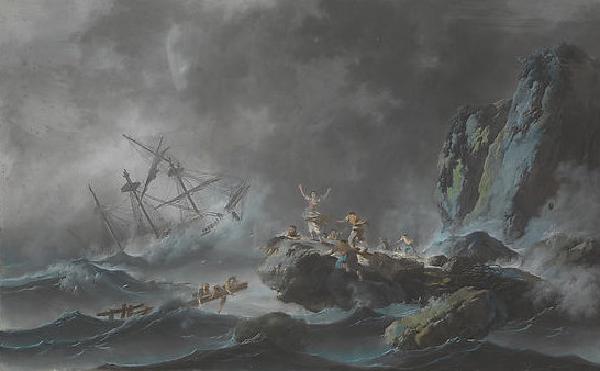

So, about a month ago, I was back east and visited the New Bedford Whaling Museum. Amongst other things, it sparked a desire to read Moby Dick.
(TLDR: Richard the Lionheart song at the end)
Perhaps like you, I’ve been afraid of this book my entire life, on bulk and reputation alone. But I bought a copy there, and I’ve been tearing it up. This book is not what you think—it’s funny and fast paced, before it turns dark—many of the chapters are just a few pages—and you’ll be halfway done before you realize it. But Moby Dick is a post for another day and another blog. We’re about Richard the Lionheart here, right?

But, I’ve been digging deep on the Age of Sail for a project I’m working on, and sea-shanties in particular. There’s sea shanties in Moby Dick, and I’m trying to track down one of them that starts:
Our captain stood upon the deck,
A spy-glass in his hand,
A viewing of those gallant whales
That blew at every strand.
Turns out it’s the traditional Greenland Whale Fisheries shanty. My project is set in the early 1700s and Moby Dick is ca. 1850. I’m wondering how old this shanty is—was it sung during the 1700s? I learn that the shanty (or its antecedent, The Greenland Voyage) might be mentioned in the 1725 book A Collection of Old Ballads.
Stick with me, we’re almost there.
So I hit the Internet Archive, which miraculously has a scanned version. Indeed, The Greenland Voyage is there, though it bears little resemblance to what we know today as the Greenland Whale Fisheries. Vaguely disappointed, I turn to the table of contents to see what else might be there.
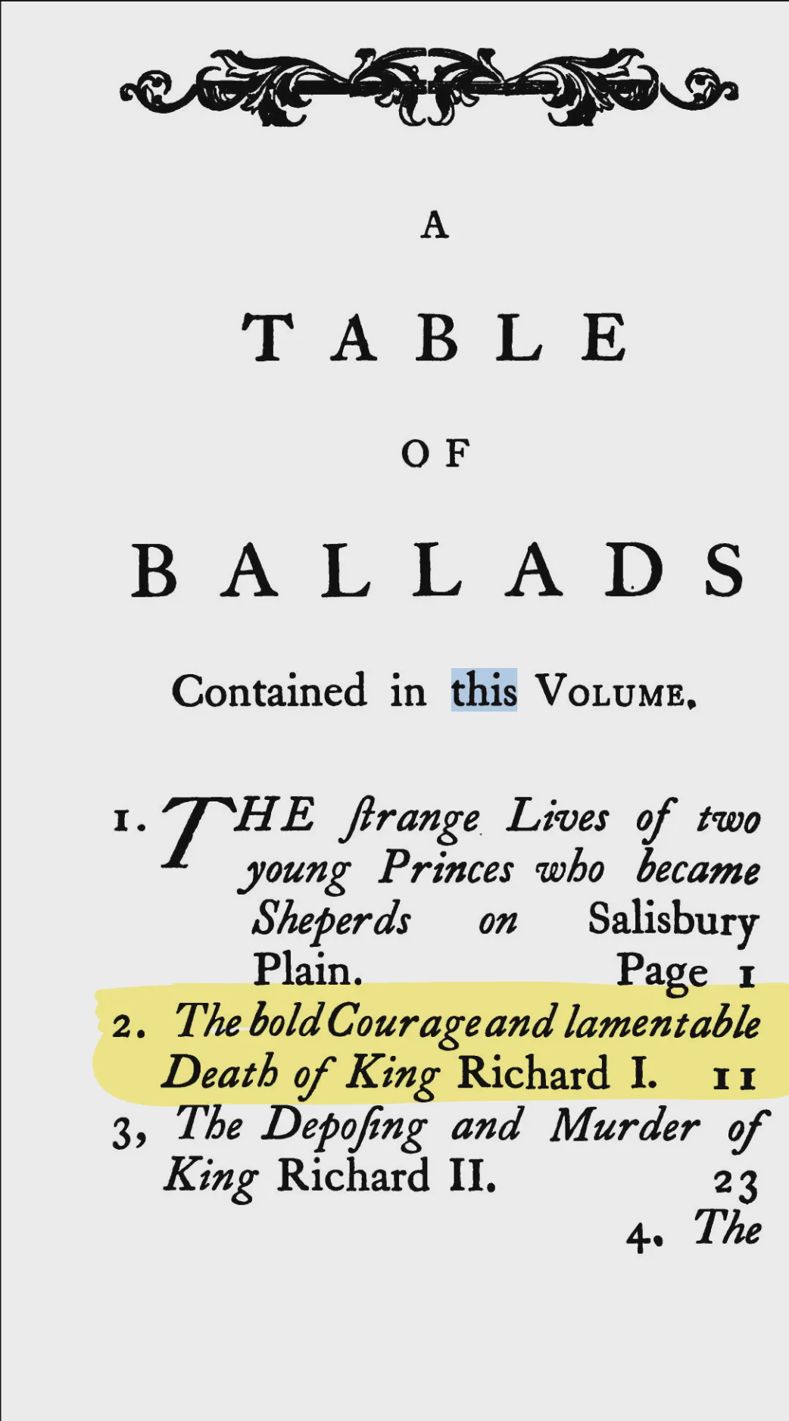
Boom. The bold Courage and lamentable Death of King Richard I.
I’ve read a lot — a lot — about King Richard and his era. Two dozen books or more, plus a million papers, articles, etc. I’ve never heard of this song. The author of the Ballads has seen fit to include a summary of Richard’s life, including (parts of) the Third Crusade, and it is solid. I’ve never seen this song before, and the book is inaccessible and archaic (ca. 1725), so I decided to transcribe and publish the full text of history and song.
But before that, here’s the fun part.
Ballads says this song is sung “To the Tune of You Batchelors, &c.” What tune is that, I wonder? Turns out there are historians of British folk tunes, just as there are historians of sea shanties. I read up. “You Batchelors” seems to refer to an old song called Advice to Batchelors, or The Married Man’s Lamentation, which was/is sung to the tune of an older song, Hey Boys up we go, which itself is derived from a yet-even-older song called Jenny Gin. I find a recording ( a few, actually ) of Jenny Gin here.
But how does does that song and melody sound with the Richard song from the book? No idea. There are of course no recordings. Hm….
AI to the rescue! Off I go to Suno, with lyrics in hand and a small recording of the source song. “Suno, please render the provided lyrics like an old English broadside ballad, sung solo, a cappella by a woman, to the tune and style of the attached mp3.”
Suno isn’t perfect at following instructions—the ‘solo a cappella’ version ends up sounding like a Pentatonix Las Vegas show—but you really can get the sense of the song, and it’s not bad!
Here’s the original tune for Jenny Gin / You Batchelors:
Now, Suno’s Song of King Richard, to the same tune: (on Suno here):
I also made a version in the style of Turpin Hero (a traditional sung by Jake Bugg that I like very much), and a version like a sea shanty.
In the style of Turpin Hero. (I did not give this run access to the Jenny Gin melody)
Sea-shanty style:
Musical Archaeology, powered by AI. It’s quite striking how Suno has preserved so much of the melody of Jenny Gin! The song kinda works!
OK, for posterity’s sake, here is the complete transcription of history and lyrics from the book. I used my OCR Workbench software, as transcribing Colonial-era books is difficult for traditional OCR. I did something similar for the letter that inspired The Tempest, if you are curious; it’s another great Age of Sail sea-adventure.
The pages from the book#
(scroll down for the song lyrics)
(ed: What’s with that &c., you might ask: it is the colonial era version of et cetera.)
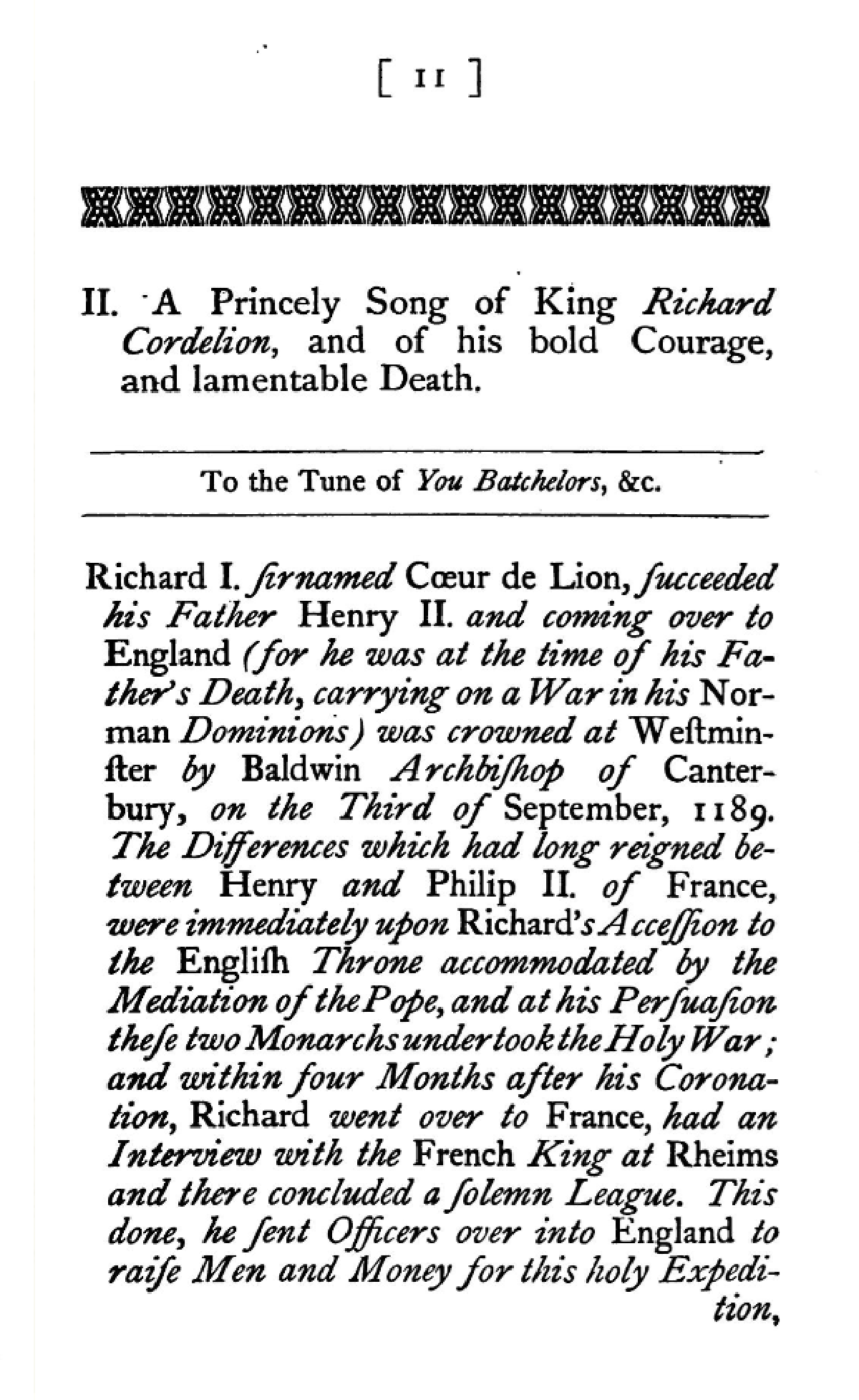
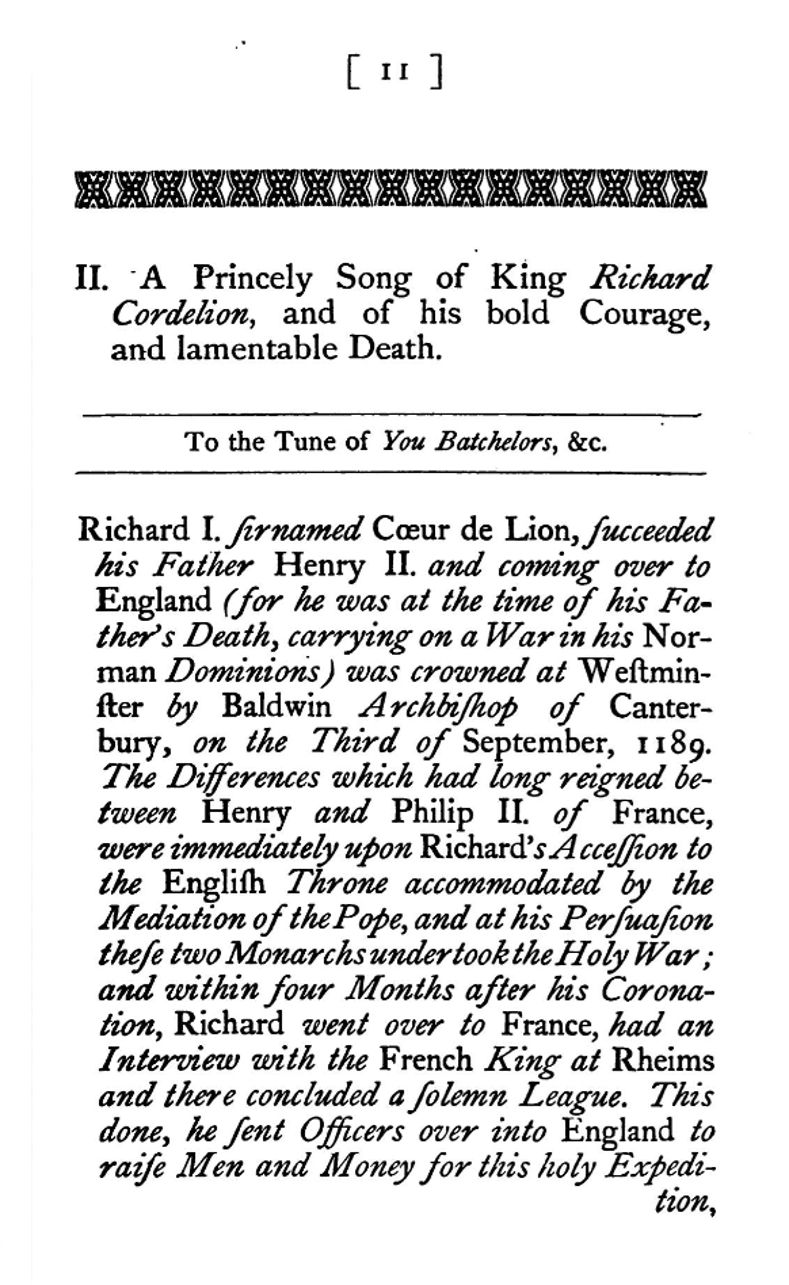
Richard I. surnamed Cœur de Lion, succeeded his Father Henry II. and coming over to England (for he was at the time of his Father’s Death, carrying on a War in his Norman Dominions) was crowned at Westminster by Baldwin Archbishop of Canterbury, on the Third of September, 1189. The Differences which had long reigned between Henry and Philip II. of France, were immediately upon Richard’s Accession to the English Throne accommodated by the Mediation of the Pope, and at his Persuasion these two Monarchs undertook the Holy War; and within four Months after his Coronation, Richard went over to France, had an Interview with the French King at Rheims and there concluded a solemn League. This done, he sent Officers over into England to raise Men and Money for this holy Expedition, who were obliged to sell and mortgage great Part of the Crown Lands, and to raise the rest by laying burthensome Taxes upon the People. To prevent any Disturbance in his Absence, he order’d his natural Brother, the Archbishop of York, one of Fair Rosamond’s Sons, to wait his Return in Normandy. Nor would he give any Part of the Administration to his Brother John, who after succeeded him, knowing him to be of a restless and ambitious Spirit; but he appointed the Bishop of Ely chief Justice of England, Keeper of the Tower, and of one of the Seals; and to confirm his Power, got the Pope to name him his Legate. And indeed this Man proved very zealous in his Master’s Service; for to supply his Master’s Wants, he neglected Popularity, and oppressed the People with heavy Taxes. The Bishop of Durham was appointed supreme Commander of the North from Humber to Scotland, and Keeper of Windsor Castle. Things thus order’d, the King determin’d to set forward; and his own Ships not being ready, he hired some Gallies at Marseilles to transport him and his to Sicily. He had not long waited there before his Ships arrived, and on Board them his Mother Eleanor, with Berengera, Daughter to the King of Navarre, to whom Richard was there betrothed, and she went forwards with him, whilst on the other hand, Eleanor returned to England. At Cyprus they refused to let him land, which made him turn his Arms against them, and he conquered the Island, and there married Berengera. The first Place the Two Kings set down before in Judea, was Acon, which they took in the Year 1191. And here they found the Ensign of Leopold Duke of Austria, which Richard ordered to be taken down, and his and the King of France’s to be set up in its stead. But here the Two Kings, who had hitherto agreed, began to side with different Parties, and to pursue different Interests. Nor could they or the Armies enjoy their Healths in that Country; Numbers of their Men died of the Bloody-Flux, which brought even the two Monarchs almost to Death’s-door. These Inconveniences joined together, made the King of France heartily sick of his holy Expedition: he would willingly have return’d Home, but durst not violate their Treaty, which set forth, that neither of them should leave the War, without the other’s immediate Permission, which Richard at first absolutely refused. At length, with much Difficulty, the French King obtain’d it, having first taken a solemn Oath, that he would not attempt ought against Richard’s Dominions; and he then return’d home, leaving our English Monarch the Honour of fighting alone in the great Christian Cause; which Richard did, not without giving Offence to some European Powers; for there were amongst the Christians of that Country several Pretenders to the Principalities of Palestine; and Richard sided with one of them against a Relation of the Emperor of Germany, by which he was so highly provoked, that he fully determined to lay hold of the first Opportunity to revenge himself. Mean while, the Intestine Troubles of England grew very great (of which some little Notice has already been taken in the 64th and 65th Pages of the first Volume) chiefly fomented by the King of France, and Earl John, who caball’d for the Crown. The Powers of the two governing Prelates clash’d, and neither would give way to the other. At length the Bishop of Ely was deposed by Earl John and his Faction, and he fled over to King Richard, to give him an Account of all that had passed. The King, by his Story, judging his Presence absolutely necessary in England, ordered his Men to follow with all convenient Speed; and in the mean time, hired three Gallies to carry him to England, with a small Retinue, intending to perform his Voyage Incognito; but being discovered by the Masters of the Galleys, and having Reason to apprehend that they had formed some treacherous Designs, he took an Opportunity of leaving them at the first Port where they put in for necessary Refreshments; and attended by one Person only, he made the best of his way by Land; but coming into the Duke of Austria’s Dominions, he was betrayed by his Servant, and seiz’d by Order of Leopold, who bore him a deadly Grudge for taking down his Ensign at Acon; but he did not long detain King Richard, selling him to the Emperor Henry VI. for 60000 Marks. Earl John laid hold of this Opportunity to carry on his Rebellion very vigorously. Proposals were made by the King’s Friends for his Ransom, which were opposed by the King of France and Earl John, who offered the Emperor a Thousand Pound a Month as long as he would detain Richard: However, his Liberty was at last procured for 100000 Marks ready Money, and Security for the Payment of 50000 more in six Months after: and thus was he set free, after having been kept Prisoner a Year and six Weeks. At his Return, he soon put an end to the Rebellion. And forasmuch as the Emperor had caused him to make some Promises which he never designed to perform, to free himself from them, he was again crowned at Win- chester the 17th of April 1194, and soon after left England to visit his Norman Dominions. He had not spent many Years there, before Widamore, Viscount of Limoges, found a considerable Treasure, part of which he sent to King Richard, as to his Sovereign Prince: But our Monarch, not content with that, demanded it all; and thinking it hid in his Castle, he besieged it; and the Castle holding out, the King, with Merchand, who commanded under him, went round it, to see which was the properest Place for beginning a general Assault: but whilst he was viewing it, he was shot in the Arm with a bearded Arrow, by one Bertram de Gurdom. This did not hinder him from giving the necessary Orders for the Attack, who commanded that when they had carried the Castle, every Soul in it should be put to the Sword, except the Man by whom he was shot, who should be reserved, and brought to him, which was accordingly done. When Bertram appear’d, the King asked him what provok’d him to do that Deed? To which he reply’d, thou didst kill my Father and two Brothers with thy own Hand, and now orderedst me to be slain. Take what Revenge thou wilt upon me, I willingly endure any Torment thou canst inflict, since I have slain thee, who hast done such and so much Mischief to the World. King Richard, pleased with his Courage, ordered him to be set at Liberty; but dying of the Wound, Bertram was retaken by Merchand, and flayed alive. This Monarch reigned nine Years and nine Months, of all which Time, he spent only eight Months in England. The Story of this King’s Reign to an unprejudic’d Reader, must appear very romantick; yet, spite of this, he is cry’d up by the Legend Writers for his holy Expedition. Our Poet writ the following Song as a Satyr upon those pious Encomiums; and to that end, has made his Story much more romantick than it actually was. The Point he seems mostly to dwell upon is, the Love of the Lady, who saves his Life, which we may plainly see is designed for the highest Piece of Satyr upon that Monarch’s Life, he not having lived with his Queen in that loving manner which would have become so pious a Prince, or which so virtuous a Princess as she really was, might have expected. This I thought necessary to premise, to prevent the petty Cavils of Witlings and wou’d-be Criticks, who, not capable of examining such a Piece, might judge it by its first outward Appearance, which indeed is but very indifferent. And had the Song really been no better than a first Sight of it would persuade us, yet would I have inserted it, intending these Books not barely for a Collection of Ballads, but for the Instruction of those who have not Leisure or Inclination to search historical Transactions; and who may, I hope, learn as much from these Abridgments, as may give them a tolerable Insight into the History of their Country.
A Noble Christian Warrior,
King Richard of this Land;
For Fame amongst our Worthies brave,
Now orderly may stand:
The God of Battels gave him still.
A gallant great Command,
To fight for our Saviour Jesus Christ.
Richard Cordelion in this Land,
A noble English Name;
It fills the World with Wonders great,
With Honour and with Fame:
Then gallantly good Soldiers all,
Come thunder out the same,
That fights, &c.
When as fair Jerusalem,
The City of our Lord,
Lay mourning all in heaviness,
Consumed by the Sword;
To succour her, all Christendom
Did willingly accord:
And to fight, &c.
Then marched forth most brave and bold
King Richard from the Land,
Of noble Knights and Gentlemen,
With him a warlike Band;
To fight for Jesus Christ his Name,
So long as he could stand:
All Soldiers of our Saviour, &c.
But by the Way such Chances there
King Richard did betide,
That many of his Soldiers
For want of Victuals dy’d:
A new Supply this noble King
Was forced to provide,
To fight for, &c.
The mighty Duke of Austria
To whom he came for Aid,
For all his kingly Courtesies,
His Succours were deny’d;
But took him Prisoner cowardly,
And basely him betray’d:
Not fighting for, &c.
His noble Knights and Soldiers then,
With Sorrows went away,
Wofully complaining all,
That e’re they saw that Day:
That such a noble King as he,
A Prisoner there should stay,
And fight not for, &c.
When they were here providing
A Ransom for his Grace,
The Duke’s own Son unreverently,
King Richard did abase;
For which with one small Box o’th’ Ear,
He kill’d him in that Place:
In Honour of our Saviour, &c.
With that into a Dungeon deep,
This noble King was cast:
Wherein a Lion (all in Rage)
Provided was in haste,
To combate with this famous King,
So long as Life did last:
The Soldier of our Saviour, &c.
But gentle Pity moved much
The Daughter of that Duke,
Who deeply wounded was with Love,
Proceeding from his Look:
For which to save his princely Life,
She kindly undertook,
In honour of our Saviour, &c.
A rich embroider’d Scarf of Silk,
She secretly convey’d
Into the Dungeon where the King,
For Execution staid;
The which to save his gentle Life,
An Instrument was made,
In honour of our Saviour, &c.
For when the hunger-starved Beast
Into the Dungeon came,
With open Mouth to swallow him,
He nimbly took the same,
And stoutly thrust it down his Ahroat,
The Lion thus to tame;
In honour of our Saviour, &c.
And so with valiant Courage he
Pull’d out the Lion’s Heart;
Which made the Duke and all his Lords,
In fearful manner start,
To see this Royal English King
To play so brave a Part,
In honour of our Saviour, &c.
I am no Prisoner, said the King,
For I am now set free,
The Country, and our Law of Arms,
Commands it so to be:
And thus to England’s blessed Land,
Most joyfully went he,
In Honour of our Saviour, &c.
But left his dearest Love behind,
That gently sav’d his Life,
With Promise to return again,
To make her then his Wife;
But still Revenge and bloody War,
Did breed them further Strife,
In fighting for our Saviour, &c.
The noble Hearts of English Men,
That could endure no Wrong,
For good King Richard mustered then
A valiant Army strong,
To pass the Seas to Acon Walls,
To lay the same along.
In Honour of our Saviour, &c.
So fierce consuming Fire and Sword,
Into that Country came;
Destroying all the Cities brave,
And Towns of antient Fame,
Till those the Wrongs King Richard had,
Were righted by the fame,
In Honour of our Saviour, &c.
But in his Prime of Martial Worth,
This noble King was slain;
For wounded with a pois’ned Shaft,
That perc’d his Princly Brain:
Such sorrowing Moan was long time made,
Amongst his warlike Train,
Still Fighting for our Savior, &c.
But chiefly by his Lady fair,
So loyal and so kind,
That nothing but Revenge thereof
Possessed still her Mind;
To know the Causer of his Death,
Were rich Rewards assigned,
To the Honour of our Saviour, &c.
Upon the Murderer (being found,)
Much Cruelty was shewn,
By her Command his Skin alive
Was fleed from Flesh and Bone;
And after into Dust and Air,
His Body it was thrown,
In Honour of our Saviour, &c.
Yet ended not this Ladies Grief,
For him she lov’d so dear,
Deep Sorrows even broke her Heart,
As plainly did appear:
And both were buried in one Grave,
Thus true Love’s End you hear,
That died for our Saviour, &c.
Did ever Lady for her Love,
More strangely undertake?
Did ever Daughter in this kind,
A grieved Father make?
Did ever Princess end her Life
Thus for her true Love’s sake?
And all for our Saviour, &c.