I’ve had a lifelong fascination with Japan, from early business trips to bus tours with my in-laws to anniversary trips. I’ve been many times, and I love it. I’m fascinated by the culture, both ancient and modern: samurai, modern jazz clubs, onsens, the opaque business etiquette, the food… Perhaps my favorite moment in Japan was climbing the seven story Himeji Castle, which felt to me as though I was in a live version of Shogun, one of my favorite books.
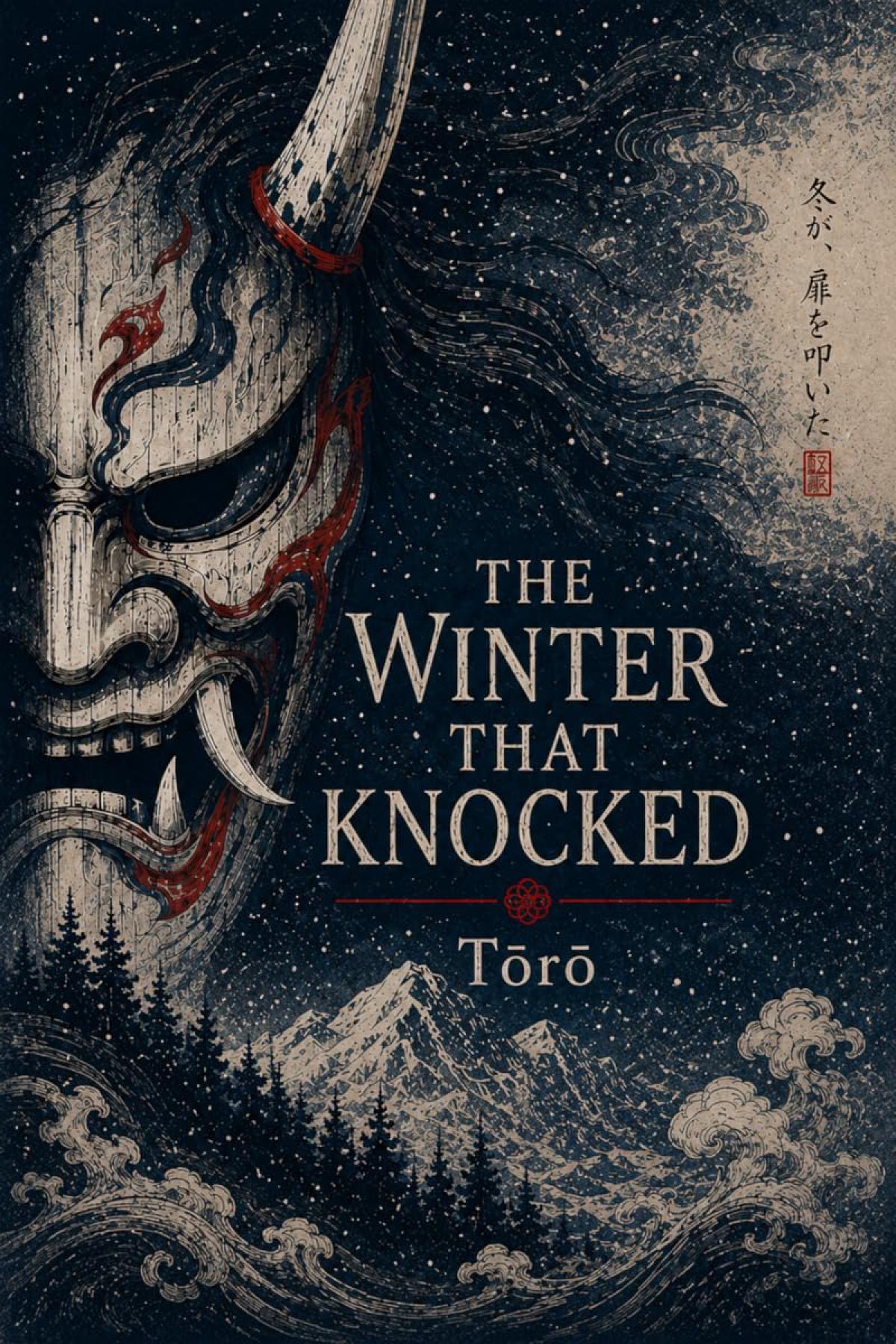
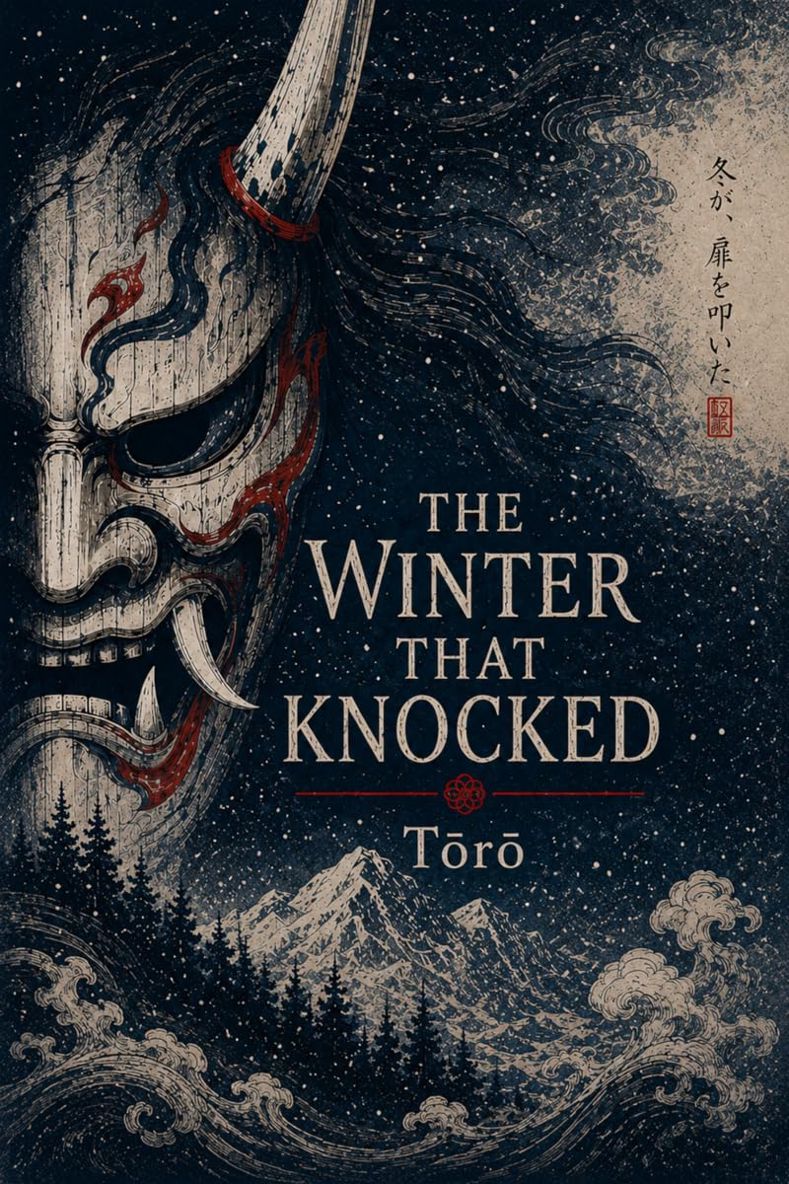
I’ve also written my first book and have been spending an enormous amount of time producing what I hope will be a striking book cover. When I stumbled on The Winter That Knocked and its amazing cover, you can imagine I dove in immediately.
What a fantastic image: beautiful, evocative, mysterious. I think I first saw it while surfing Pinterest for inspiration. After a moment’s reflection, I decided the image was AI generated, for reasons that don’t articulate quickly. Still, a writer might easily use an AI-generated cover for their book. I’ve considered it myself; getting a professionally designed book cover is expensive, and there’s no guarantee you’ll get what you imagine.
As I had a long plane flight the next day, I immediately downloaded the book. $3.99, a no-brainer. I read it cover to cover on the flight(s). Well, not cover to cover, it was an ebook. I loved it. It’s a Japanese gothic, filled with remote mountains, old ghosts, onsen villages, and a modern heroine trying to figure things out as she deals with longstanding family drama. As if Kawabata’s Snow Country were crossed with the TV series A Murder at the End of the World.
BTW: this is a track my soundtrack as I read: Japanese ambient electronica. It’s perfect for this book.
The writing is interesting. It’s very metaphorical. It has interesting rhythms and is periodically repetitive in strange ways. Not grammatically repetitive; rather, characteristics of people are mentioned more than once, though slightly rephrased. At times I almost suspected editing mistakes, as if a passage from one chapter had inadvertently landed in another, but after editing. Some quotes from the book to give you the flavor of it.
The place was less a home than a sealed thought.
And when they were feeling especially lazy, they reduced her to Akita Bijin1, as if beauty from the north were a regional product, like rice or cedar or snow.
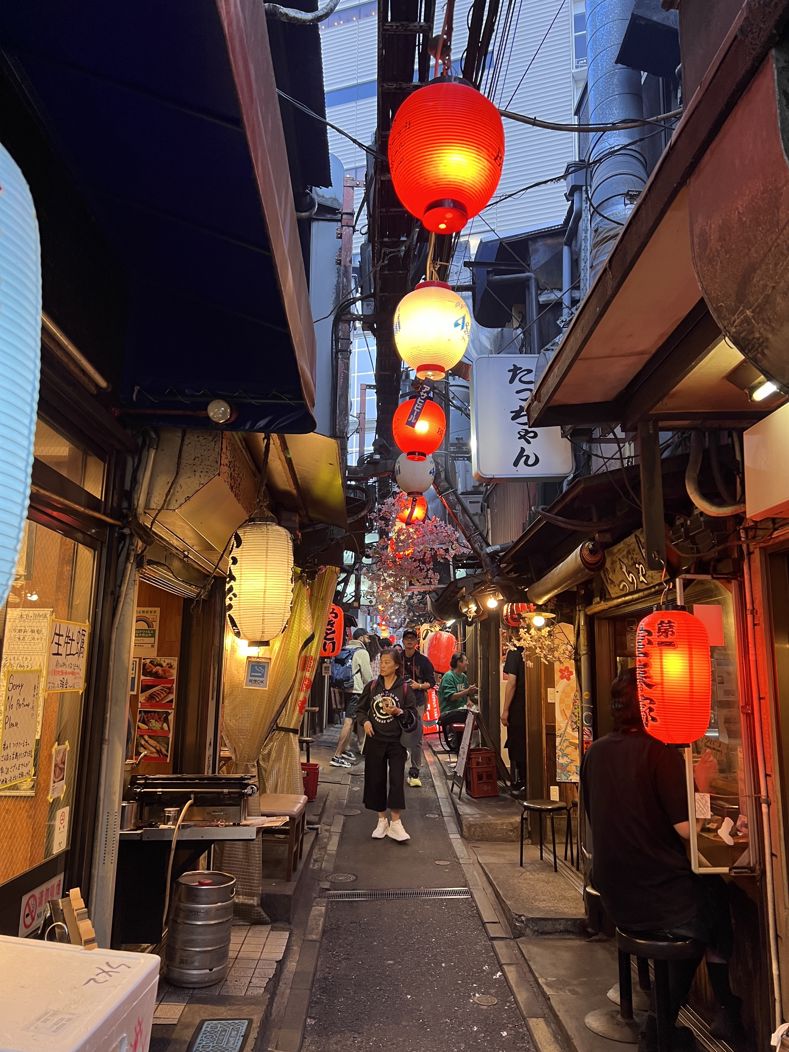
On Omoide Yokocho, one of my favorite spots on Tokyo, just outside Shinjuku station:
More than sixty bars and restaurants were packed there, shoulder to shoulder, the air fragrant with charcoal, tare, offal, beer foam, wet wool, and the kind of nostalgia that cities sometimes monetize because genuine memory is too expensive.
Shuji Ando was taller than she had expected, perhaps because museum men in her imagination always turned out slighter than their responsibilities. He was in his early forties, she guessed, with the physical self-command of a person who had spent years making stillness look like neutrality. He wore a charcoal jacket over a black turtleneck, the kind of clothing that passed in institutional settings for both seriousness and taste. His face would not have been called handsome immediately by someone inattentive, but prolonged looking would have rewarded it. His features were clean and narrow through the cheeks, broader at the brow, with a straight nose and a mouth whose natural set suggested restraint rather than severity. There was something almost architectural about the way his face held itself - planes and lines rather than softness. His skin had the pale gold cast of a man who lived more under artificial light than outdoors. His hair, dark and slightly wavy, had been cut recently but not vainly; a few strands had already begun to escape at the temple. What unsettled her most were his eyes: a clear brown, steady, unhurried, and too observant for comfort. They looked like the eyes of a man who knew that curation always involved omission.
Nyuto Onsen: seven hot springs, deep in the mountains near Lake Tazawa, in the foothills of Mount Nyuto, ringed by virgin beech forest in Towada-Hachimantai National Park. Old inns. Snow country. A place that had drawn Akita’s feudal lords centuries earlier to recover from travel and battle. Even on the glossy official pages it looked secluded enough to become a thought before it became a destination. Beech trunks pale against snow. Sulfurous steam rising from baths half-swallowed by woods. Road signs diminishing into white. The journey from Tazawako Station took about forty-five minutes by bus. Mio stared at the photographs until the screenshine turned them unreal.
She knew enough from her late-night reading that Nyuto Onsen was not a single inn but a dispersed hot-spring settlement in the foothills of Mount Nyuto, a cluster of seven old baths and inns in the beech forests northeast of Lake Tazawa, where domain lords once came to recover from travel and battle and where the springs rose from deep under the forested ground. But knowledge in the abstract had not prepared her for the sensation of approach. The bus did not seem to take her toward leisure or scenic escape. It took her toward enclosure - toward a pocket of older topography where roads narrowed, snowbanks rose, and the world’s surfaces began to give less back to the eye.
The ryokan sat low against the snow, less built than weathered into visibility. It had thatched roofs darkened by age and weather, deep eaves, timber blackened almost to charcoal in places, and small windows whose yellow light seemed less electrical than inhabited. A plume of steam rose somewhere behind the main structure and drifted sideways across the whiteness. The approach was not grand. A lane of packed snow. A wooden sign half-buried at its base. A row of outbuildings and walkways roofed against winter. Nothing in it sought to impress. Everything in it suggested duration.
To summarize: I really enjoyed the book. It opened a part of Japan to me that I had not been to, exposed me to some of the legends of the Japanese countryside, and inspired in me a desire to travel there.
But somewhere around page 60 (but not before!), I began to suspect the book had been written with AI. Or alternatively that it had been translated from the original Japanese (there is a Japanese edition)… I began to look for evidence the book was written by/with AI, even as I raced to the conclusion, finishing somewhere over the Pacific, halfway to Hawaii. Honestly, I was hoping for a typo or a grammatical error, something to prove to me the writer was human. No such luck. Well edited, or written by AI.
Evidence?#
In the text itself, I found none of the usual markers of AI writing - no emdashes (much as I detest that emdashes imply AI), no stilted or formal grammatical constructions, no eager-to-please feeling. Rather, the text was elliptical, metaphorical, sometimes even overwritten, the so-called “purple prose.”
I begin to cast about for evidence the book might be AI-written outside the book itself.
I was curious about the author. The English writing was sophisticated, so I suspected a native speaker. The knowledge of Japan seemed deep, which made me wonder. The book deals with family trauma, so I wondered whether the author had experienced it. The author is named Tō Rō.
Little is available online about the author; essentially, nothing. No website, no major social media presence except for a few anonymous posts on Facebook and Reddit. All of that suggested someone with a deep desire for privacy or a distinct lack of interest in being known as the author. In another post the author talks about an AI-developed game on Japanese train etiquette (what an odd/fun game!), so… there’s that. Competence and interest in AI.
Similarly, I could find little about the book. It’s independently published. There’s no website for the book, very few online reviews, and no blog tours. It felt almost like the book had been cast into the void to see if anyone would read it. I began to look for other evidence the book might be AI-written.
I ran some of the text through AI detectors. Pangram and another tool (I forget which) says the first 4 paragraphs of chapter 2 are 100% AI generated, though it does give reasons. The same test of my 2nd chapter, thankfully, says 100% human.
Simultaneous release of both English and Japanese versions, and the fact that the book is independently published, suggests the use of AI in at least one of the cases.
There are just a few reviews of the book. One of them says definitively the book is AI written (no evidence, just assertion) and encourages you not to buy it.
None of this is definitive of course, merely suggestive. (I’d be delighted to hear from the author, of course!)
Writing and AI#
In the writing world, using AI to write a book is taboo. Awards are rescinded. Noses are upturned. The writers that I know or are familiar with mostly view it as almost a moral crime. Many of them feel AI itself is a moral crime. I don’t feel that way, but I understand their logic. The models are often trained on pirated copies of books under copyright, the authors uncompensated. I have a more nuanced view. AI is a tool. Much as the printing press put medieval scribes out of work but created new jobs, AI will eliminate some things and allow other things to come into creation. I’ve written a bit more about that elsewhere. I understand the feeling that AI has been created unethically (that is certainly true in varying degrees), but it’s here.
My interest here is to not to condemn, but to examine the impact on the reader, and on the author.
Impact on the reader#
As a reader, how does knowing a book was AI written impact my relationship with the work? I found interesting emotional insights in this book. The book inspired me and educated me. And it was entertaining, even if the people occasionally behaved in ways that felt off to me (though human written characters often do this to me too). As I read, I was asking myself, “Does it matter that the author is human?” I’d like to think so. But what are we to do with authors that are completely Hidden, say, Elena Ferrante. Nobody knows who she is, or even if she is a “she”. Can I have a relationship with a mystery? The fact that she is human or not human doesn’t really matter because I don’t know anything about her. But I want it to matter.
Many of the books that I read are pure entertainment, not deep, emotional works speaking to the human condition. Does it really matter that Jack Reacher books are written by a human? I think the argument is less clear there. What is art? What is entertainment? Is it okay if entertainment is written by a bot, but art must be written by a human? What is the difference between art and entertainment anyway.
The author#
Fiction, even medieval historical fiction like my first novel, is usually informed by some issue the author is wrestling with. Joan Didion famously said “I write entirely to find out what I’m thinking, what I’m looking at, what I see and what it means.”
In my case, that was my experiences as a CEO, and the constant battle between doing what felt “right,” and what was “necessary.” That became embodied in Richard the Lionheart and the Third Crusade, the crusades being ripe with ethical quandries. I could have used AI to write this book, although I wrote most of it before AI was mature. But why would I? That’s not the point. I wasn’t writing to be finished, the Journey was the destination, as they say. I was writing to understand, to learn. AI would not have helped me do that.
In professional work, say, software engineering, I use AI without even thinking about it. The productivity gains are so magnificent, and the point is to “be done”, not to “do the work.” Particularly for mundane, repetitive tasks. That the models are sometimes trained on content they had no right to: I grant the point. Most technological leaps have some moral quandary in their beginning history. My writing is certainly trained on all the books I’ve read. Is that stealing? And I think not using the technology is simply not recognizing that this is going to happen one way or the other. You can either embrace it or be left behind.
Akita Bijin (秋田美人) literally means “beauty from Akita” and is a regional expression for a woman considered especially attractive. ↩︎